
The pharmaceutical manufacturing landscape is becoming increasingly complex. A greater diversity of drug modalities is progressing through development pipelines, including small-volume personalized medicines and therapies targeting rare diseases. As a result, manufacturers need flexible facilities capable of efficiently producing multiple products at different scales.
Multiproduct and shared pharmaceutical manufacturing facilities can help meet that need. They enable manufacturers to use common infrastructure and equipment across different products while supporting greater flexibility and more efficient capacity utilization.
That flexibility, however, creates an important challenge: How can manufacturers reduce cross-contamination risk while maintaining the speed and operational efficiency that make shared facilities valuable in the first place?
Effective cross-contamination prevention requires more than cleaning equipment between campaigns. Manufacturers need a risk-based contamination control strategy that considers facility design, equipment selection, cleaning validation, personnel and material flows, product changeovers, single-use technologies and sterile fluid transfer.
Why are multiproduct manufacturing facilities becoming more important?
Using the same manufacturing facility and equipment for multiple products can provide significant operational advantages.
Multiproduct manufacturing allows drug producers to respond more rapidly to changes in demand while improving utilization of manufacturing capacity. It can also reduce capital expenditures by limiting the need to construct and maintain dedicated facilities for every product.1
Additional advantages can include reduced operating costs and improved time to market. Equipment may also receive more consistent maintenance because systems are used regularly rather than sitting idle for extended periods. Processes performed on standardized platforms can provide greater operational consistency than completely independent dedicated manufacturing environments.1
These advantages are particularly valuable as biopharmaceutical pipelines become more diverse and production volumes vary widely across products.
The same flexibility that makes shared manufacturing environments attractive, however, increases the importance of contamination control.
What causes cross-contamination in shared pharmaceutical manufacturing facilities?
Cross-contamination occurs when materials associated with one product or manufacturing process unintentionally contaminate another product, process or manufacturing environment.
In a multiproduct facility, the concern extends far beyond residual drug substance remaining inside processing equipment.2
Potential sources of cross-contamination include:
- Residual product on equipment and product-contact surfaces
- Non-product-contact surfaces within manufacturing areas
- Operators moving between production spaces
- Material and waste transfer points
- Aerosolized compounds distributed through facility air
- Improperly controlled fluid transfer operations
- Equipment failures or compromised system integrity
- Inadequate cleaning during product changeovers2
The consequences can affect product quality and potentially patient safety. When highly potent compounds are manufactured within the same facility, effective control becomes even more critical.2
FDA guidance reinforces the importance of preventing contamination in nondedicated equipment and facilities through appropriate cleaning, cleaning validation and other contamination controls. Facility layouts and the movement of personnel, materials and equipment should likewise be designed to minimize contamination risk.3
Why is “visibly clean” not enough?
A surface that appears clean does not necessarily meet scientifically established criteria for safe product changeover.
Modern pharmaceutical manufacturing therefore relies on health-based and risk-based exposure limits to determine acceptable levels of residual drug substances.
The International Society for Pharmaceutical Engineering introduced the concept of the Acceptable Daily Exposure (ADE) limit through its Risk-Based Manufacture of Pharmaceutical Products (Risk-MaPP) framework. ADE represents a daily exposure level at which adverse health effects are not expected over a lifetime of exposure.4
The European Medicines Agency subsequently introduced the concept of Permitted Daily Exposure (PDE) limits through guidance addressing health-based exposure limits for medicinal products manufactured in shared facilities.5
Residual drug substance levels must remain below established health-based limits for equipment to be considered sufficiently clean.
ADE and PDE values may also be used with Maximum Allowable Carryover (MACO) calculations. MACO calculations help manufacturers consider factors such as shared surface area and establish acceptable residue limits when equipment is used across different products.6
These values support a broader risk-based approach to cross-contamination prevention and equipment cleanliness.6,7
ICH Q9(R1), Quality Risk Management, provides an overarching framework for identifying, evaluating and controlling risks affecting pharmaceutical quality. The revised guideline emphasizes risk-based decision-making and the use of quality risk management throughout pharmaceutical manufacturing.8
Why is cleaning validation critical in multiproduct manufacturing?
Cleaning validation demonstrates that a defined cleaning procedure can consistently remove product residues and other contaminants to predetermined acceptable levels. For shared equipment, that evidence is particularly important.
FDA guidance states that cleaning procedures should normally be validated where contamination or carryover poses a meaningful risk to product quality. For shared equipment, cleaning validation is intended to demonstrate that carryover between products does not compromise product safety or efficacy.3,9
Developing an effective cleaning validation program requires a detailed understanding of the complete manufacturing environment, including:2,6
The production process. Manufacturers must understand where product residues may accumulate and which processing steps present the greatest contamination risk.
The drug substance and drug product. Toxicity, potency, solubility and other product characteristics influence cleaning requirements and acceptable residue levels.
The equipment. Geometry, materials of construction and difficult-to-access areas can significantly affect cleanability.
The facility. Manufacturing layouts and personnel or material movement can create contamination pathways beyond direct product-contact surfaces.
The analytical methods. Testing methods must be sufficiently sensitive, robust and fit for purpose to confirm that residues remain within established limits.9
Cleaning procedures should ideally account for worst-case conditions, including products that are particularly difficult to remove and equipment areas that are most challenging to clean.2,9 Procedures must also be documented and supported by records demonstrating ongoing effectiveness.9 Cleaning validation therefore is not simply an end-of-process verification step. It is part of a larger contamination-control strategy that begins with the design of the manufacturing environment itself.
How can facility design reduce cross-contamination risk?
Thoughtful facility design can make cleaning validation more effective while reducing the opportunities for contamination to occur.2,6,10
In multiproduct facilities, upstream processing, downstream processing and media or buffer preparation can be segregated into defined process areas. The movement of personnel, raw materials, products and waste should also be carefully considered. Where appropriate, unidirectional flows can help prevent materials leaving one manufacturing area from becoming a contamination source elsewhere in the facility.3,10
Air handling is another important consideration. Controlled air flows can reduce the possibility that aerosolized compounds will migrate into other production areas.2,10 Facility flexibility can be incorporated into the design as well. For example, configurable cleanroom systems may allow manufacturers to adapt production areas as processing needs change.10
The objective is not simply to create barriers. It is to design the facility so contamination control is supported by the natural flow of manufacturing operations.
What equipment characteristics support multiproduct manufacturing?
Equipment selection can have a significant impact on both cross-contamination risk and the operational burden required to control it.
Stainless-steel equipment used in GMP manufacturing environments should be designed for effective cleaning. Systems should minimize crevices where residues can accumulate and provide sufficient drainability after cleaning.2 Closed and contained processing equipment can provide another important layer of protection by limiting the release of particulates and aerosols into the surrounding environment.2
Equipment integrity should also be confirmed before and after use to reduce the possibility that failures create unintended contamination pathways.2 Beyond individual equipment design, manufacturers should consider how many transfer steps a process requires. Every material or fluid transfer introduces another point at which contamination can potentially occur.2
Production scheduling can also play a role. Campaign planning that considers product potency and limits unnecessary changeovers can reduce both contamination risk and the operational burden associated with repeated equipment cleaning.2
Finally, operator training remains essential. Personnel need to understand contamination risks as well as the procedures required for cleaning, handling and movement between manufacturing areas.2
How do single-use technologies reduce cross-contamination risk?
For many multiproduct biopharmaceutical manufacturing environments, single-use bioprocessing technologies provide one of the most effective ways to reduce cross-contamination risk.
Traditional stainless-steel systems require cleaning between products as well as extensive cleaning validation. These activities consume time and manufacturing resources. They also require utilities and generate waste streams that must subsequently be managed.11
Single-use systems change that operating model.
Pre-sterilized disposable technologies are now available across many bioprocess unit operations, including upstream processing, downstream processing, fill/finish, buffer and media preparation, and fluid transfer.10,11 Because product-contact components can be replaced between processes, single-use technologies can significantly reduce the opportunity for product carryover.
They can also provide important operational benefits:
Reduced cleaning requirements. Disposable product-contact components eliminate many traditional cleaning steps.
Faster setup and changeover. Manufacturers can transition between products without lengthy cleaning cycles for reusable product-contact components.
Reduced cleaning validation burden. Eliminating reusable product-contact surfaces can reduce the scope of cleaning validation required between processes.
Closed processing. Well-designed single-use systems can support closed manufacturing strategies that reduce exposure to the surrounding environment.
Fewer manual interventions. Integrated single-use workflows can decrease handling steps where contamination may otherwise be introduced.
Greater manufacturing flexibility. Disposable technologies can make it easier to adapt production environments to changing products or production volumes.10,11
For flexible multiproduct pharmaceutical manufacturing, single-use technologies have therefore become an important tool for simultaneously improving operational efficiency and supporting contamination control.
Why do sterile fluid transfers remain a critical contamination-control point?
Replacing reusable equipment with single-use components does not eliminate every contamination risk. Fluids still need to move between process steps. Whether a facility primarily uses stainless-steel equipment, single-use assemblies or a hybrid manufacturing model, fluid transfer operations remain a potential point of exposure to microbes, particulates and product residues.
Establishing secure sterile connections is therefore an important component of a broader bioprocess contamination-control strategy.
Sterile tube welding is an established method for connecting compatible thermoplastic tubing while maintaining a closed fluid pathway. Sterile connecting devices create sterile welds between compatible tubing, allowing connections to be made without exposing the internal fluid pathway to the surrounding environment.12
The technology can therefore support closed processing and reduce opportunities for contamination during fluid transfer.
Conventional sterile tube welding technology, however, can introduce its own operational limitations.
Traditional systems may be cumbersome and difficult to position in constrained manufacturing spaces. Some require adapters when welding tubing of different sizes. Others are limited in the tubing materials they can accommodate.
For manufacturers building increasingly flexible single-use workflows, those limitations can create unnecessary complexity.
A more flexible approach to sterile tube welding
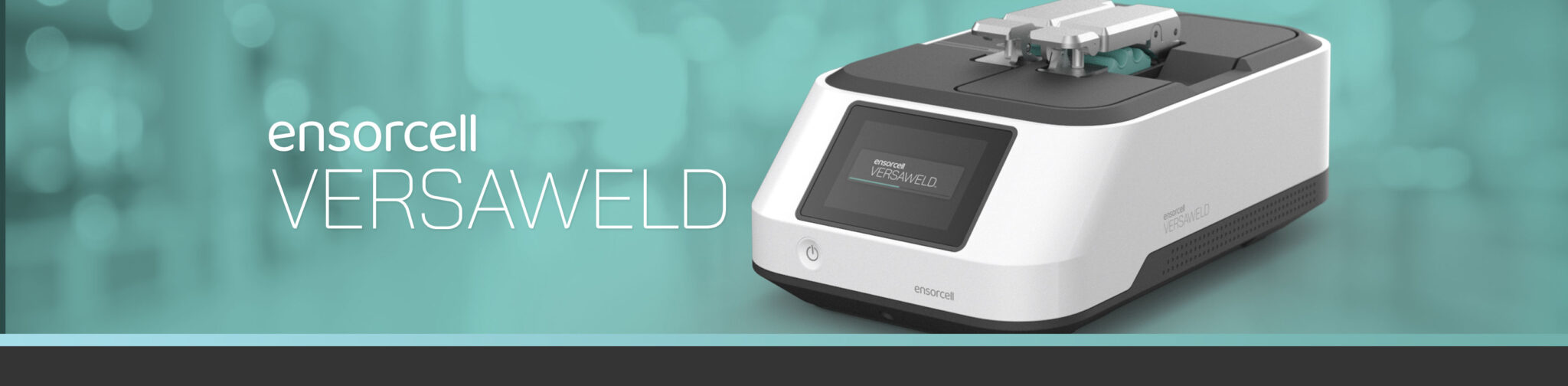
Ensorcell developed the Versaweld™ sterile tube welder to rethink how sterile tube welding can fit into modern bioprocess workflows. Versaweld is a compact and portable sterile tube welding system designed for use in biopharmaceutical R&D and manufacturing environments.
The system eliminates the need for separate cutting wires and heating elements and supports quick, reliable sterile welds across several process configurations.
Versaweld supports:
- Dry-to-dry sterile tube welding
- Dry-to-wet sterile tube welding
- Wet-to-wet sterile tube welding
- Liquid-filled applications
- Multiple thermoplastic tubing sizes and types
- Portable use across bioprocess environments
- Sterile connection workflows without a single-use blade13
Its compact design can also help address one of the practical challenges associated with conventional sterile tube welders: positioning equipment where the process actually takes place.13
The objective is straightforward. Sterile connection technology should support the flexibility of modern bioprocessing rather than constrain it.
For shared and multiproduct manufacturing facilities, technologies that simplify closed sterile connections can complement broader contamination-control strategies while helping reduce time, space and operational complexity.
How can manufacturers build a more complete cross-contamination prevention strategy?
There is no single technology or procedure that eliminates cross-contamination risk in a multiproduct pharmaceutical manufacturing facility. Effective contamination control is layered.
Cleaning validation provides evidence that reusable equipment can be safely transitioned between products. Facility design reduces contamination pathways. Closed processing limits exposure to the surrounding environment. Single-use technologies reduce product-contact carryover. Thoughtfully designed sterile fluid-transfer solutions help maintain closed systems as materials move between unit operations.
Together, these controls support the flexibility manufacturers increasingly need without losing sight of the fundamental objective: protecting product quality and patient safety.
As pharmaceutical and biopharmaceutical manufacturing continues to support more products, more modalities and increasingly flexible production models, equipment should evolve alongside those changing requirements.
For Ensorcell, that means looking carefully at established bioprocessing technologies and asking a simple question:
How can this work better for the people who actually use it?
Versaweld is one answer, a reimagined approach to sterile tube welding designed around portability, flexibility and the practical needs of modern bioprocessing environments.
References
1. Peter Boeddeker, “Using a Risk-Based Approach to Manufacturing in a Multi-Product Facility,” *Pharma’s Almanac*, May 29, 2018.
2. Tote Systems, “Cross-Contamination Control in Multi-Product Facilities: A Complete Guide,” *Tote Guide*, March 2, 2026.
3. U.S. Food and Drug Administration, “Questions and Answers on Current Good Manufacturing Practice Requirements — Equipment.” See discussion of nondedicated equipment, facility design and cleaning validation.
4. International Society for Pharmaceutical Engineering (ISPE), *Baseline Guide: Risk-Based Manufacture of Pharmaceutical Products (Risk-MaPP).*
5. European Medicines Agency (EMA), *Guideline on Setting Health Based Exposure Limits for Use in Risk Identification in the Manufacture of Different Medicinal Products in Shared Facilities.*
6. Edward V. Sargent et al., “The Regulatory Framework for Preventing Cross-Contamination of Pharmaceutical Products: History and Considerations for the Future,” *Regulatory Toxicology and Pharmacology*, 79 Suppl. 1 (2016): S3–S10. doi:10.1016/j.yrtph.2016.05.029.
7. Cynthia A. Challener, “Managing Cleaning Validation in Multi-Product Biologics Facilities,” *BioPharm International*, 27(9), 2014.
8. International Council for Harmonisation (ICH), *ICH Harmonised Guideline Q9(R1): Quality Risk Management*, Final Version, January 18, 2023.
9. U.S. Food and Drug Administration, *Q7 Good Manufacturing Practice Guidance for Active Pharmaceutical Ingredients*, Section 12.7, Cleaning Validation.
10. Catherine Jomary and Cecilia Devlin, “The Challenges of Multiproduct Facility Design,” *IPS Insights*.
11. “How a Biopharma Plant Reduced Cross-Contamination Using Single-Use Assemblies,” *Biopharma Dynamics Blog*, March 26, 2026.
12. U.S. Food and Drug Administration, *Use of Sterile Connecting Devices in Blood Bank Practices: Guidance for Industry*. FDA Center for Biologics Evaluation and Research.
13. Ensorcell, *Versaweld™ Sterile Tube Welder* product specifications and technical documentation.