
Maintaining sterility is fundamental to safe and effective biopharmaceutical manufacturing. In aseptic processing environments, even minor contamination risks can compromise product quality, regulatory compliance, and patient safety.
To ensure sterile fluid transfer across single-use bioprocessing systems, manufacturers rely on connection technologies such as aseptic connectors and sterile tube welding. As production models shift toward more flexible, small-batch, and multi-product workflows, the choice of connection method has become increasingly important.
Understanding the differences between portable tube welders and fixed systems is therefore essential for optimizing performance, cost, and operational flexibility in modern biomanufacturing environments.
Many injectable therapies, including biologics and advanced therapeutics, cannot undergo terminal sterilization using heat or radiation without degradation. As a result, sterility must be maintained throughout the entire manufacturing process rather than applied at the final stage.
The critical role of sterile connections in biopharma production
This requirement places significant importance on fluid transfer operations, where materials move between bioprocessing systems. Any break in sterility during these steps can introduce contamination, leading to batch failure or compliance risks.
To address this challenge, biopharma manufacturers rely on validated sterile connection methods, including sterile tube welding and aseptic connectors. These technologies enable secure, contamination-free integration of components while supporting the scalability and flexibility required in modern single-use and modular manufacturing environments.
Why sterile connections matter in aseptic processing
Aseptic processing environments are designed to prevent contamination at every stage of biopharmaceutical manufacturing, making sterile connections a critical component of overall process integrity. As the industry continues to adopt single-use bioprocessing tubing and disposable fluid transfer systems, maintaining sterility across these interconnected systems has become both more important and more complex.
These environments are typically established within highly controlled cleanrooms that regulate airflow, enforce strict gowning procedures, and incorporate multiple layers of contamination control. In parallel, many facilities now utilize advanced closed production systems such as restricted access barrier systems (RABS) and isolators to further reduce exposure risk.
The growing use of single-use technologies, including pre-sterilized bioreactors, sampling bags, buffer containers, filters, and tubing assemblies, has significantly improved operational efficiency. Because these components are delivered ready for use, they eliminate the need for cleaning and sterilization between batches, enabling faster setup and reducing both time and cost.
However, while single-use systems simplify many aspects of production, they also increase the number of required fluid transfer points throughout a process. Each of these connections must maintain sterility without introducing variability or complexity. As a result, the reliability and consistency of sterile connection methods play a central role in supporting safe, efficient, and scalable aseptic manufacturing workflows.
What is sterile tube welding in biopharma?
Sterile tube welding is a method used to create contamination-free connections between thermoplastic tubing in bioprocessing environments.
The process involves:
- Heating tubing ends using thermal or laser energy
- Fusing the tubing together under controlled conditions
- Creating a sterile, leak-proof connection without exposing fluid pathways to the external environment
This technique is widely used in bioprocessing fluid transfer systems, particularly in applications involving: single-use assemblies, bioreactors and mixing systems, sampling and buffer transfer, and cell and gene therapy workflows.
Because sterile tube welding eliminates the need for external connectors or fittings, it reduces contamination risk and simplifies system design.
While aseptic connectors are widely used, aseptic connectors vs tube welding is an important consideration due to potential contamination risks, lack of standardization, and added complexity in multi-connection systems.
What are the options for sterile connections in biomanufacturing?
Maintaining sterility during all operations, including liquid transfers, is essential to ensuring successful aseptic processing. Tubing is used to transfer fluids between different pieces of equipment. It must be leak-proof, free of contamination, and connected to the equipment in a way that maintains sterility.
There are two main options for achieving these connections: using aseptic connectors or via sterile tube welding, in which heat or lasers are used to fuse two pieces of tubing made of a thermoplastic elastomer together.
Aseptic connectors
Aseptic connectors use pre-sterilized fittings that allow tubing to be joined without exposing the fluid pathway.
Limitations include:
- Lack of standardization across suppliers
- Requirement for pre-attached connectors
- Increased system complexity with multiple connections
- Potential contamination risk from fittings and handling
Sterile tube welding
Sterile tube welding creates a direct connection between tubing segments without additional components.
Advantages include:
- Reduced contamination risk
- Compatibility with a wide range of tubing sizes
- Elimination of external fittings
- Simplified workflows
For many applications, aseptic connectors vs tube welding becomes a question of flexibility, scalability, and risk tolerance.
Supporting flexible and scalable biomanufacturing
The shift toward modular and flexible biomanufacturing is driving increased adoption of portable, small-footprint tools.
Key trends include: growth of cell and gene therapy manufacturing, increased use of single-use technologies, demand for faster facility setup and reconfiguration, and expansion of decentralized manufacturing models.
Portable tube welders align with these trends by enabling, rapid deployment across facilities, simplified workflows, and reduced infrastructure requirements
As a result, they play an important role in building scalable and adaptable production environments.
Portable tube welder vs fixed systems: How Ensorcell supports sterile connections in bioprocessing
Both portable tube welders and fixed systems are used in biopharma environments, but they serve different operational needs.
Fixed tube welders are best suited for high-volume applications where consistent long-term performance is required. Advanced portable, automated systems offer many advantages in all other applications, including clinical trial material and personified medicine (cell/gene therapy) manufacturing, as well as in flexible, small-batch, multi-product production facilities. They carry a lower upfront cost, can be used in the field, in laboratories and small maintenance shops, and on the production floor where there may be limited space, and are easily moved from one site to the other, affording significant flexibility.
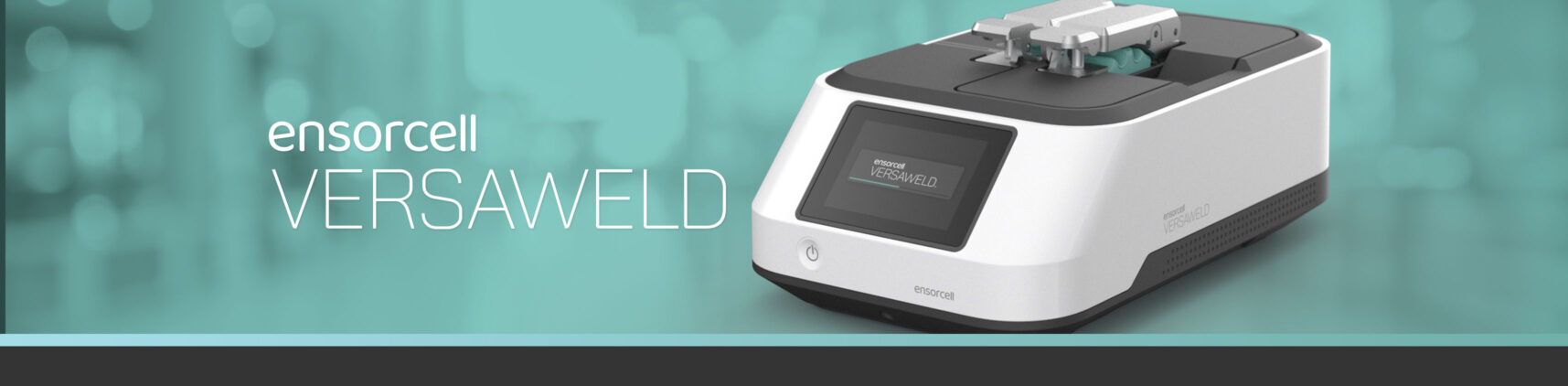
The Versaweld™ sterile tube welder is a great example of an affordable, compact, portable tube welder. This state-of-the-art system enables easy sterile tube welding in a variety of biopharmaceutical environments including on lab benches, in biosafety cabinets and hoods, and in production spaces. Notably, Versaweld delivers quick, reliable sterile welds—dry-to-dry, dry-to-wet, and wet-to-wet—without the need for single-use blades. This user-friendly solution ensures consistent performance while saving time, space, and cost in R&D and bioprocess applications.
You can read more about the Versaweld tube welder here.
What are the benefits of portable tube welders?
Portable tube welders offer several advantages in modern bioprocessing environments:
- Flexibility for use across multiple locations
- Reduced equipment footprint in space-constrained facilities
- Lower upfront cost compared to fixed systems
- Support for small-batch and personalized medicine production
- Compatibility with single-use bioprocessing tubing
- Reliable sterile connections without additional consumables
These features make portable systems well-suited for next-generation biopharma manufacturing models.
Conclusion
As biopharmaceutical manufacturing continues to evolve, the need for flexible, efficient, and reliable sterile connection methods is increasing.
Sterile tube welding provides a robust solution for maintaining sterility in single-use systems, while portable tube welders offer the adaptability required for modern production environments.
By selecting the appropriate connection method based on workflow, scale, and facility design, organizations can improve efficiency, reduce risk, and support scalable manufacturing operations.
Become an early adopter of Ensorcell products in your lab – get in touch today!